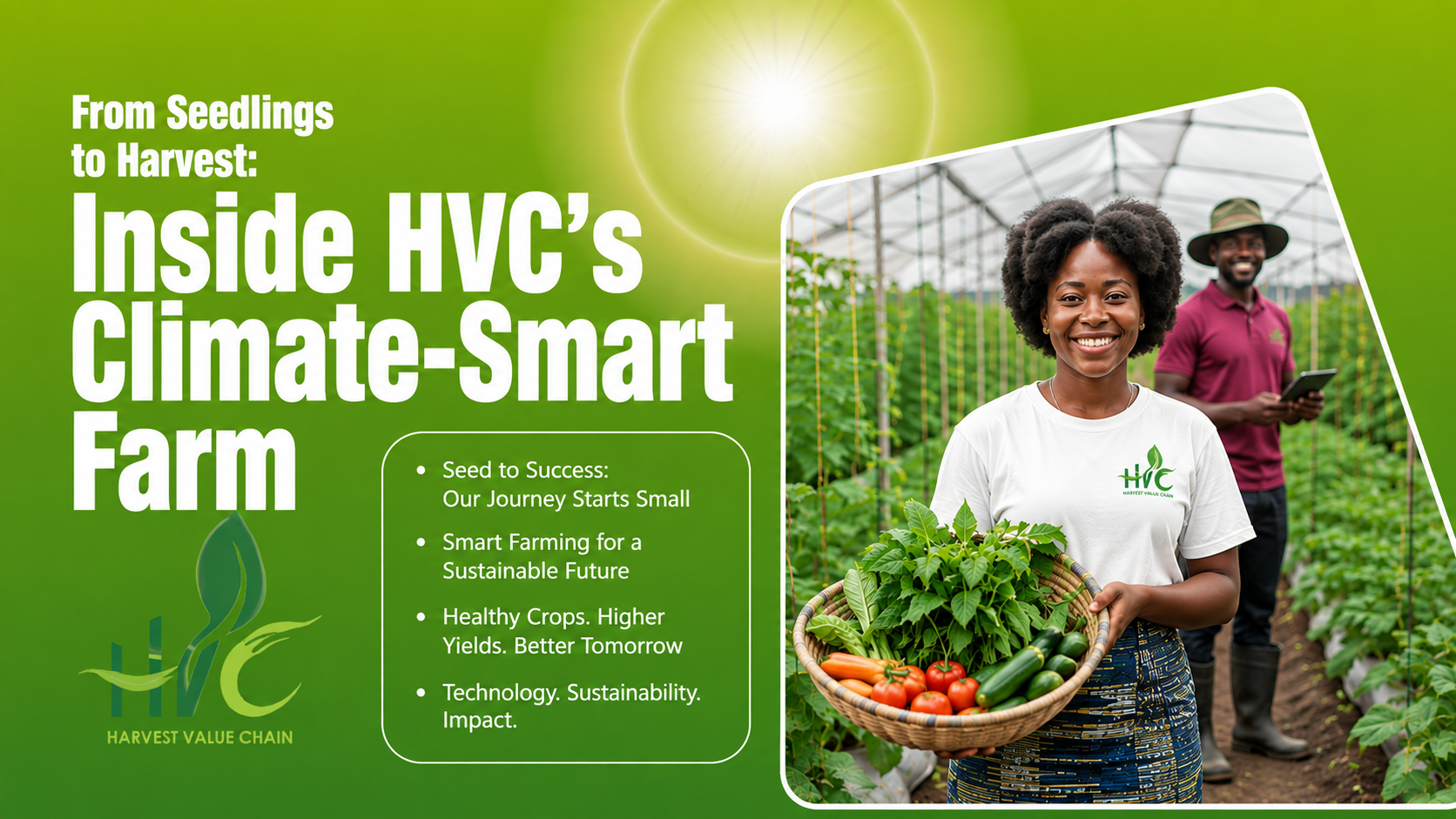
Inside HVC’s Climate-Smart Farm: Growing 1,000 Crops in a Modern Greenhouse
Agriculture is changing rapidly, and modern farming systems are creating new ways to produce more food with greater efficiency, better resource management, and less dependence on traditional farming methods.
At HVC, this transformation is taking shape through an expanding climate-smart agricultural project that combines greenhouse crop production with fish farming. The project is currently developing a 40 ft × 40 ft greenhouse, with an ambitious target of establishing approximately 1,000 grow bags and Dutch buckets for the production of habanero peppers, cucumbers, and tomatoes.
The project is already close to achieving this target.
From Tiny Seeds to Productive Crops
Every harvest begins with something remarkably small: a seed.
The production process starts in the nursery, where habanero pepper, cucumber, and tomato seeds are carefully sown in nursery trays. At this stage, close attention is given to the developing seedlings because strong plants begin with healthy roots and proper early growth.
Once the seedlings have developed sufficiently and are strong enough for the next stage, they are transplanted into the main production system.
Rather than being planted directly into conventional soil beds, the crops are grown using a combination of Dutch bucket hydroponic systems and grow bags. This allows the farm to manage the growing environment more deliberately while making efficient use of available space.
The grow bags are filled with water-soaked rice bran, which serves as the growing medium. This approach provides an alternative to traditional soil-based production and forms part of the farm’s broader effort to adopt more controlled and resource-efficient production techniques.
A 40 ft × 40 ft Greenhouse with a Big Ambition
The greenhouse may occupy a relatively compact footprint, but the production target is significant.
The goal is to establish approximately 1,000 growing units containing habanero peppers, cucumbers, and tomatoes.
Achieving this requires more than simply placing plants inside a greenhouse. The success of a high-density production system depends on careful planning, crop spacing, nursery management, transplanting, irrigation, nutrition, pest and disease management, and continuous monitoring.
The controlled environment provided by greenhouse production can also give farmers greater control over important factors affecting crop growth.
For HVC, the greenhouse therefore represents more than a structure for protecting crops. It is part of a production model designed to demonstrate how modern agricultural systems can maximize productivity within limited spaces.
Why Dutch Buckets and Grow Bags?
The use of Dutch buckets and grow bags provides flexibility in how different crops are cultivated.
Dutch bucket systems are particularly useful for crops such as tomatoes and cucumbers because they provide an organized growing structure while allowing water and nutrients to be delivered directly to the plants.
Grow bags, meanwhile, provide another practical way of cultivating crops without relying entirely on traditional soil beds.
Together, these systems allow the farm to explore different production approaches and optimize its available greenhouse space.
The goal is straightforward: produce healthy crops efficiently while making better use of available land and production resources.
Fish Farming: Another Key Part of the HVC Project
Crop production is only one part of the HVC agricultural operation.
The project also includes fish farming, with tanks stocked with healthy fish. Fish production adds another important dimension to the project and demonstrates the potential of integrating different agricultural activities within a broader farming system.
Managing fish production requires its own set of responsibilities, including feeding, water management, monitoring fish health, and maintaining suitable conditions for growth.
By incorporating aquaculture alongside crop production, HVC is developing an agricultural model that extends beyond a single crop or farming activity.
Conventional Production with a Climate-Smart Approach
While HVC’s production methods incorporate modern and climate-smart technologies, the crop production system should not be described as organic farming.
The crops are primarily produced using synthetic farming practices, with controlled production systems designed to improve efficiency and productivity.
Climate-smart agriculture does not necessarily mean organic agriculture. The two concepts are different.
A climate-smart approach focuses on improving productivity, adapting agricultural production to environmental challenges, and using resources more efficiently. This can involve technologies such as greenhouse production, controlled irrigation, hydroponic systems, improved crop management, and other modern farming practices.
For HVC, the focus is therefore on combining modern production technology with efficient farm management, rather than positioning the operation as an organic farm.
Managing the Entire Production Cycle
One of the defining characteristics of the HVC project is its involvement across multiple stages of production.
The process begins with nursery establishment and continues through seedling development, transplanting, crop management, and eventual harvesting. On the aquaculture side, the project also manages fish husbandry from stocking through growth and maintenance.
This hands-on approach provides the team with practical experience across the entire production cycle.
It also creates an opportunity to identify challenges at each stage and improve the system over time.
Building a More Productive Agricultural Future
The HVC project reflects a broader shift taking place in agriculture: moving from simply cultivating crops to developing integrated, technology-driven production systems.
A 40 ft × 40 ft greenhouse containing hundreds of growing units, combined with fish production, demonstrates how farmers can explore intensive production models even where land is limited.
The journey toward 1,000 grow bags and Dutch buckets is not simply about reaching a numerical target. It represents an effort to build a more structured and efficient agricultural production system—one that combines crop cultivation, aquaculture, controlled environments, and practical farm management.
As the greenhouse approaches full capacity, HVC’s experience will provide valuable lessons about what it takes to establish and manage intensive crop production in a modern African farming environment.
From tiny seeds in nursery trays to productive plants in Dutch buckets and grow bags, and from stocked fish tanks to daily farm management, the HVC project is demonstrating that the future of agriculture can be both productive and innovative.
Leave a Reply