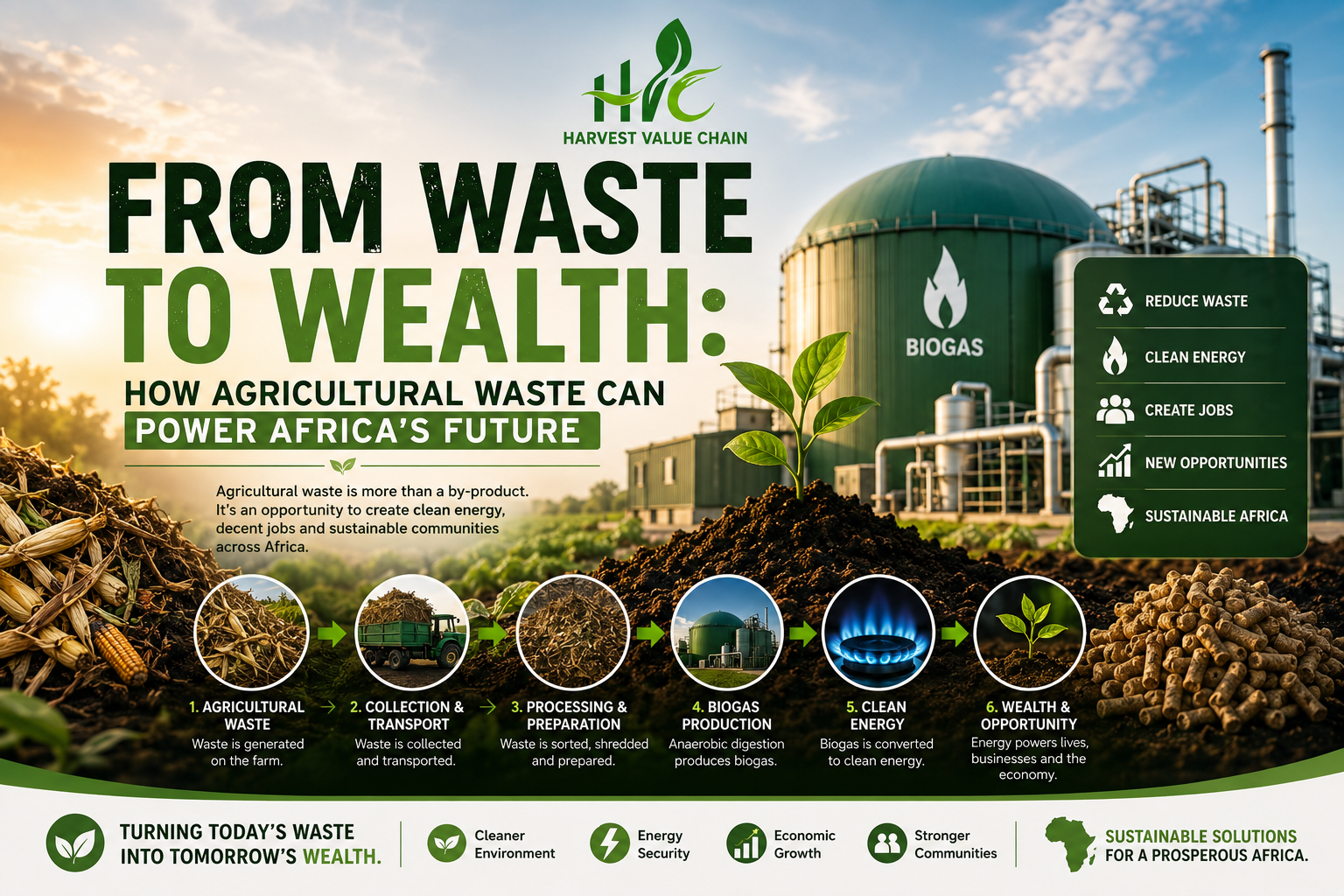
A Harvest Value Chain Limited Insight
Every day across African farms, markets, and food processing facilities, tonnes of organic material are discarded. Crop residues are burned in open fields. Animal waste piles up untouched. Cassava peels, rice husks, groundnut shells, and fruit peels are dumped as if they have no value.
But waste is not the end of the story. In many cases, it is the beginning of a new one.
Across the continent, a growing number of entrepreneurs, researchers, and institutions are treating agricultural waste not as a disposal problem, but as a raw material. Properly managed, that same waste can become fuel, fertilizer, animal feed, construction material, and income. This shift, commonly described as “waste to wealth,” is quietly becoming one of Africa’s most practical sustainability opportunities.
The Scale of the Problem
Agriculture generates waste at every stage: on the farm, during transport, at processing, and in markets. This includes crop residues such as maize stalks, rice husks, and groundnut shells, animal waste from livestock and poultry operations, fruit and vegetable peels and off-cuts, and processing by-products from cassava, palm oil, and grain milling.
The Food and Agriculture Organization (FAO) has repeatedly highlighted post-harvest losses and food waste as major inefficiencies across African agrifood systems, noting that significant volumes of food are lost between harvest and the final consumer. When this waste is left unmanaged, it does more than represent lost value. It pollutes waterways, attracts pests and disease, contributes to methane emissions when it decomposes in open piles, and creates health and sanitation hazards in farming communities.
The good news is that nearly every category of agricultural waste has a productive second life, if it is captured and processed correctly.
Turning Waste Into Wealth: The Key Pathways
1. Waste to Energy
Organic waste such as animal manure and crop residues can be converted into biogas through anaerobic digestion, producing clean fuel for cooking, heating, and even electricity generation. This is already happening at household and small-cooperative level across parts of rural Africa, and it directly addresses two problems at once: unreliable, expensive energy access and unmanaged farm waste.
Rice husks, groundnut shells, and other dry crop residues can also be converted into briquettes, an alternative to firewood and charcoal that burns more efficiently and produces less smoke.
2. Waste to Fertilizer and Soil Improvement
Composting remains one of the simplest and most accessible ways to convert organic waste into value. Crop residues, market waste, and animal manure can be broken down into nutrient-rich compost that improves soil structure and reduces farmers’ dependence on expensive chemical fertilizers.
This is particularly important given the volatility of fertilizer prices, which are closely tied to global energy costs and exchange rate movements. A farmer or cooperative that can produce its own organic fertilizer from local waste builds real resilience against those price shocks.
3. Waste to Animal Feed
Certain agricultural by-products, such as cassava peels, brewers’ spent grain, and fruit and vegetable off cuts, can be processed into livestock and poultry feed. Feed is typically one of the largest recurring costs in livestock production, so converting waste into a feed input can materially improve margins for both the waste producer and the livestock farmer purchasing it.
This also strengthens the connection between different parts of the agricultural value chain, turning what would be two separate cost centers (waste disposal and feed purchase) into a single value-generating exchange.
4. Waste to Construction and Industrial Materials
Some agricultural residues, including rice husks and groundnut shells, are increasingly being explored as raw material for building products, insulation, and other industrial applications. While this pathway requires more technical processing and investment than composting or feed production, it points to a longer-term opportunity: agricultural waste as an input into entirely different industries.
5. Waste to Packaging
Fibrous agricultural residues can also be processed into biodegradable packaging materials, offering an alternative to plastic packaging in food and consumer goods. As environmental regulation and consumer preference shift toward sustainable packaging, this is an area likely to see growing interest.
Why This Matters for Rural and Agricultural Communities
For smallholder farmers and rural communities, waste-to-wealth models offer several concrete benefits.
1. Additional income streams; Waste that was previously discarded can be sold, processed, or converted into products with commercial value, whether that’s compost, biogas, briquettes, or animal feed.
2. Reduced input costs; Converting waste into fertilizer or feed reduces dependence on purchased inputs, insulating farmers somewhat from price volatility.
Improved sanitation and health outcomes. Managed waste reduces water contamination, pest infestation, and the health hazards associated with open dumping or burning.
3. Lower environmental impact; Diverting organic waste from open decomposition or burning reduces methane and other emissions, aligning with the growing emphasis on climate-smart agriculture across the continent.
The Barriers That Still Exist
Turning waste into wealth is not automatic, and it is worth being honest about the challenges.
Awareness and technical knowledge; Many farmers and communities are simply not aware of the conversion methods available or lack the technical training to implement them properly.
Upfront investment; Composting systems, biogas digesters, briquette machines, and feed processing equipment all require some capital investment that smallholders may not have readily available.
Inconsistent waste supply; Some conversion processes need a steady, sufficiently large volume of waste to be commercially viable, which can be a challenge for individual smallholders operating at small scale.
Limited market linkages; Even when a farmer or cooperative successfully produces compost, briquettes, or feed, they still need buyers. Without market access, the “wealth” side of waste-to-wealth remains theoretical.
This is precisely why aggregation and cooperative models matter so much in this space. A group of farmers pooling waste, sharing processing equipment, and jointly accessing markets can overcome most of these barriers far more easily than an individual smallholder working alone.
A Continental Opportunity, Not Just a Local Fix
Waste-to-wealth is gaining institutional attention well beyond individual farms. Nigeria’s 2026 AGROW project, backed by a $500 million World Bank commitment, places explicit emphasis on post-harvest handling, value addition, and strengthening agricultural value chains, all of which intersect directly with better waste management. FAOs continued focus on reducing food loss and waste across agrifood systems reinforces that this is not a niche concern but a structural priority for African agriculture.
As climate pressures, input costs, and energy access challenges continue to shape the agricultural landscape, waste-to-wealth approaches offer something rare: a solution that is simultaneously environmentally sound, economically productive, and achievable at a relatively small scale.
The Bottom Line
Agricultural waste has long been treated as an unavoidable cost of doing business. But across Africa, that assumption is being challenged. Manure becomes fuel and fertilizer. Husks become briquettes and building material. Peels become animal feed. What was once a disposal problem becomes a second revenue stream.
The shift from waste to wealth requires knowledge, some investment, and stronger market connections, but it does not require reinventing agriculture. It requires looking more closely at what is already there.
At Harvest Value Chain Limited, we work with farmers and cooperatives across Ilorin and Kwara State to strengthen the full agricultural value chain, including practical approaches to waste management, value addition, and market access. If your farm or community generates waste that could become a resource, we would be glad to explore that opportunity with you.
The future of African agriculture will not only be measured by what we grow. It will also be measured by what we do with what is left behind.
- Finding the Next Useful Form of Agricultural Matter, Where Nothing Is Truly Waste
- Harvest Value Chain Champions Circular and Sustainable Agriculture In Kwara State (CIWACIWE)
- How Post-Harvest Value Addition Reshapes Agricultural Enterprise
- NiMet’s 21–31 August Flash-Flood Outlook: What It Means for Agriculture, Infrastructure and Logistics
- How Climate-Smart Agriculture is Shaping Africa’s Food Future
About Harvest Value Chain Limit
Harvest Value Chain Limited (HVC) is focused on building practical solutions across the agricultural value chain, from production and value addition to market connections and sustainable resource use. Follow HVC for more practical insights on agribusiness, agriculture, value addition, sustainability, and opportunities within Africa’s food system
Leave a Reply