What Investors Look for Before Funding Agribusinesses
A Harvest Value Chain Limited Insight
At Harvest Value Chain Limited, we work every day at the intersection of farmers, processors, aggregators and the markets that connect them. One question we hear often from agripreneurs and cooperatives across Ilorin and beyond is simple: “How do we get investors to take us seriously?
Agriculture is one of Africa’s biggest economic opportunities, but having a good farming idea is not enough to attract investment.
Agrifood systems in developing countries face a major financing gap, while small and medium-sized agribusinesses often struggle to access the capital needed to expand. In sub-Saharan Africa, FAO reports that three out of four small and medium agricultural enterprises lack sufficient access to finance.
So, what makes one agribusiness more attractive to investors than another?
1. A Clear and Profitable Business Model
Investors need to understand exactly how your agribusiness makes money.
It is not enough to say, “We produce food.” You need to explain what you sell, who buys it, how much they pay, what it costs to produce, and how the business generates profit.
For example, an agribusiness producing tomatoes should be able to demonstrate:
- Production capacity
- Cost per unit
- Selling price
- Target customers
- Expected profit margins
- Distribution channels
The clearer the economics, the easier it becomes for an investor to assess the opportunity.
2. Evidence of Market Demand
A large agricultural market does not automatically mean your business will succeed.
Investors want evidence that customers actually want your product.
This could include existing sales, repeat customers, purchase agreements, partnerships with distributors, customer data, or a strong pipeline of buyers.
If you are already generating revenue, even better.
This is particularly important in agricultural value chains, where improving market access and strengthening connections between producers, processors, aggregators, and buyers can determine whether an opportunity becomes commercially viable. Nigeria’s 2026 AGROW project, for example, specifically emphasizes aggregation, post-harvest handling, value addition, and improved market access. (World Bank)
3. Strong Financial Records
Investors don’t want financial guesswork.
They want realistic projections supported by actual business data. Your agribusiness should have clear records of revenue, expenses, cash flow, assets, liabilities, and profitability.
You should know your:
- Cost of production
- Gross margin
- Operating expenses
- Break-even point
- Working-capital requirements
- Expected return on investment
If you cannot explain where your money goes, convincing someone else to invest theirs becomes much harder.
4. Scalability
Investors want to know whether your business can grow. A scalable agribusiness should have a clear pathway to increasing production, sales, or market reach without costs increasing at the same rate.
This could come through:
- Technology
- Improved production systems
- Processing facilities
- Contract farming
- Distribution networks
- Strategic partnerships
- Expansion into new markets
For African agribusinesses, value-chain development is especially important because investment opportunities extend beyond farming into processing, logistics, storage, aggregation, and market access. Recent FAO-supported investment programmes have financed projects across numerous agricultural value chains and placed significant emphasis on agrifood SMEs and companies working with smallholders. (FAO Home)
5. A Strong Management Team
Investors are investing in people as much as they are investing in the business.
They want founders who understand their industry, can execute a strategy, manage people, solve problems, and adapt when conditions change.
You don’t necessarily need a huge team.
But you do need the right capabilities.
If the founder understands agricultural production but lacks financial, operational, technological, or marketing expertise, the business should have people who can fill those gaps.
6. Risk Management
Agribusiness comes with serious risks. Weather, pests, diseases, commodity-price fluctuations, supply-chain disruptions, energy costs, climate shocks, and regulatory changes can all affect profitability. Investors want to know that you have identified these risks and developed strategies to manage them.
That could involve:
- Crop or agricultural insurance
- Diversified suppliers
- Irrigation
- Multiple distribution channels
- Storage facilities
- Buyer contracts
- Emergency reserves
- Climate-smart production methods
FAO research highlights the importance of finance and risk-management tools in helping farmers and agrifood businesses invest, while agricultural insurance can help protect incomes against climate-related shocks. (FAOHome)
The goal isn’t to eliminate every risk.
That’s impossible.
The goal is to demonstrate that you understand your risks and have a credible plan for managing them.
7. Value Addition
One of the biggest opportunities in African agriculture is moving beyond the production of raw commodities.
Processing, packaging, preservation, storage, logistics, and distribution can create additional value and open new revenue streams.
Instead of simply selling cassava, for example, an entrepreneur could explore opportunities in processed food products, starch, animal feed, or other higher-value applications.
Nigeria’s AGROW programme specifically identifies value addition through agro-processing as an important component of strengthening agricultural value chains and attracting private investment. (World Bank)
The more value a business can create efficiently, the stronger its investment proposition can become.
8. A Defensible Competitive Advantage
Investors will eventually ask: “Why can’t someone else copy this?”
Your advantage could come from:
- Proprietary technology
- Strong distribution networks
- Exclusive supplier relationships
- Strategic partnerships
- Unique data
- Brand strength
- Operational efficiency
- Access to difficult-to-reach markets
If your entire strategy can be copied by someone with slightly more money, your competitive advantage is weak.
9. Proper Legal and Operational Structure
A promising business can still lose investor interest if its foundation is messy.
Investors need confidence that the business is properly structured and capable of handling external capital.
That means having appropriate registration, contracts, financial records, ownership documentation, licences where required, and clearly defined business processes.
The goal is to demonstrate that you are building a company , not simply running an informal project.
10. A Clear Use of Funds
Finally, investors want to know exactly what their money will accomplish.
Don’t simply say: “We need ₦50 million to expand.” Break it down.
For example:
- ₦20 million for production equipment
- ₦10 million for working capital
- ₦8 million for distribution
- ₦5 million for storage
- ₦7 million for technology and operations
Then explain what those investments are expected to achieve: higher production, lower costs, increased revenue, improved efficiency, or entry into new markets.
A strong funding proposal connects capital → activity → measurable outcome.
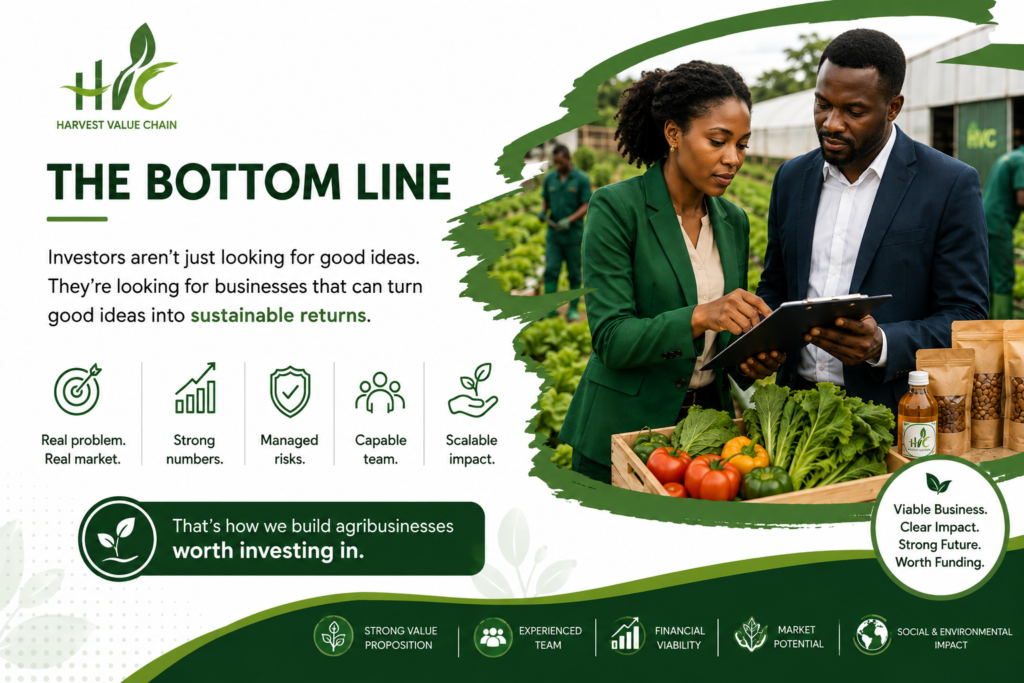
The Bottom Line
Agribusiness investment isn’t simply about having access to land or producing food.
Investors are looking for businesses with strong economics, real market demand, capable teams, manageable risks, and a credible path to scale.
The financing environment is evolving, too. FAO notes that innovative financing mechanisms such as impact investing, blended finance, de-risking instruments, and other investment structures are increasingly being explored to address the financing needs of agrifood systems. (FAOHome)
Nigeria is also seeing increased institutional attention toward agricultural value chains. In 2026, the World Bank approved a $500 million AGROW project designed to strengthen agricultural value chains and mobilize additional private agribusiness investment in Nigeria. (World Bank)
For entrepreneurs, the message is simple: Don’t pitch agriculture. Pitch a business.
Show investors the problem, the market, the numbers, the risks, the competitive advantage, and exactly how their capital will create measurable growth.
How Harvest Value Chain Limited Can Help
At Harvest Value Chain Limited, we work alongside farmers, cooperatives, and agribusinesses to strengthen exactly the areas investors care about most from aggregation and post-harvest handling to market linkages and value addition.
If you’re building an agribusiness in Ilorin or across Kwara State and preparing to raise capital, we are happy to be a partner in that journey.
Because investors aren’t simply looking for good ideas. They’re looking for businesses that can turn good ideas into sustainable returns.
Because investors aren’t simply looking for good ideas.
They’re looking for businesses that can turn good ideas into sustainable returns.
References
- FAO Investment Centre. The dos and don’ts of blended finance in agrifood systems: The case of investment funds (2026). Read the FAO report
- FAO Investment Centre. How farmers’ access to finance boosts investment in agrifood systems (2025). Read the FAO research brief
- FAO Investment Centre. Innovative Finance. Explore FAO’s investment and finance work
- World Bank. Nigeria: World Bank Approves Project to Expand Agricultural Value Chains and Jobs (2026). Read the World Bank announcement
Leave a Reply