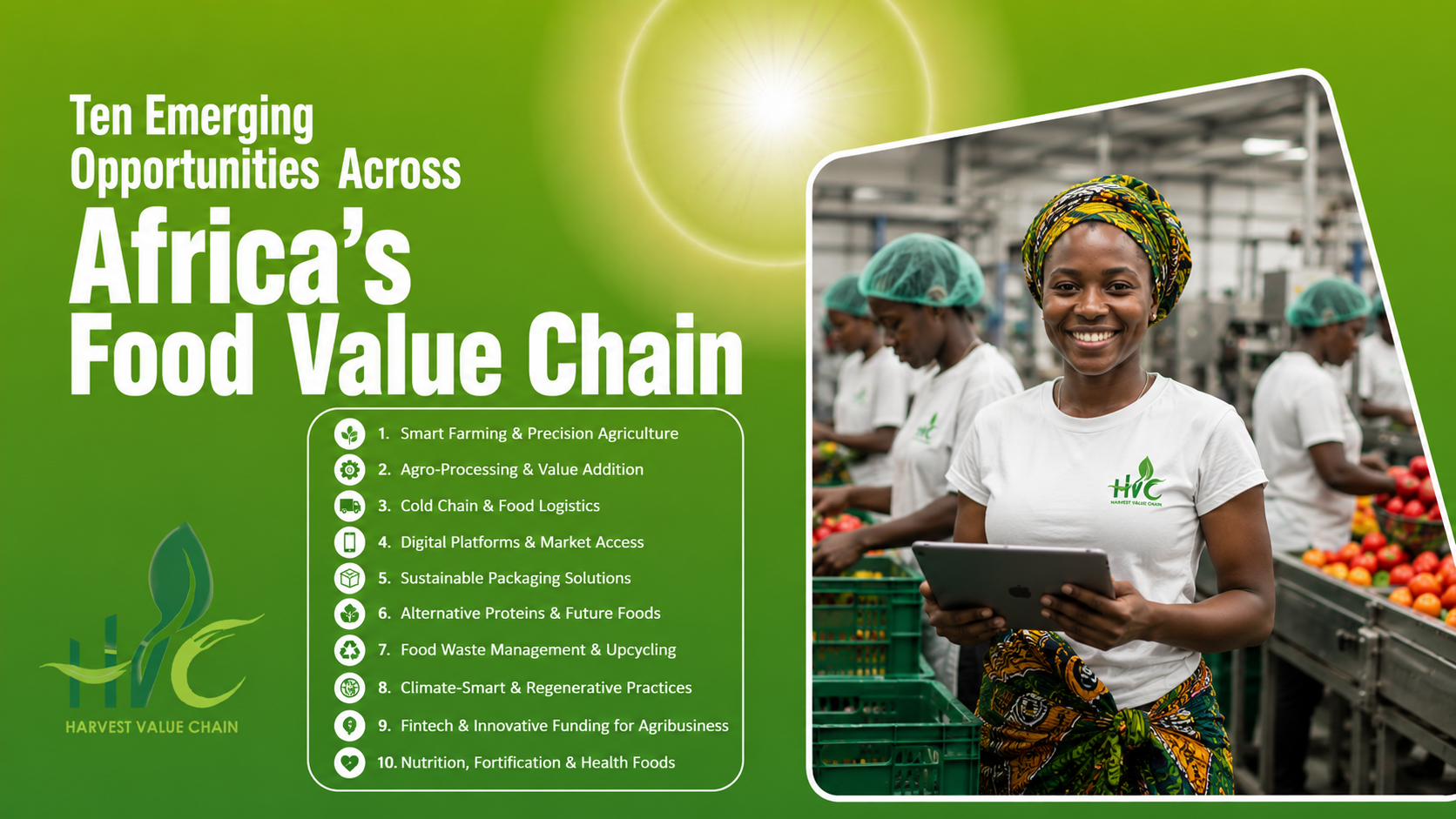
10 Emerging Opportunities Across Africa’s Food Value Chain
A Harvest Value Chain Limited Insight
Africa’s food economy is changing fast. Population growth, urbanisation, technology and rising demand for processed food are creating opportunities far beyond traditional farming.
The real opportunity is not just producing food. It is solving the problems between the farm and the consumer. From processing and logistics to digital platforms and waste recovery, here are 10 opportunities worth watching.
1. Agro-Processing and Value Addition
Africa produces huge volumes of agricultural commodities, but much of their potential value is lost when they are sold in raw form. Entrepreneurs can turn cassava into flour and starch, tomatoes into paste, fruits into juices, and peppers into packaged spices.
The opportunity: buy, process, package and sell agricultural products at higher value.
2. Cold Storage and Post-Harvest Solutions
Food does not become valuable simply because it has been harvested. It has to reach the market in good condition. Poor storage, transportation and refrigeration contribute significantly to food losses across Africa.
This creates opportunities in:
- Solar-powered cold rooms
- Refrigerated transport
- Produce storage
- Packhouses
- Temperature monitoring
The opportunity: help farmers and businesses preserve food for longer and sell when market conditions are better.
3. Agricultural Aggregation
Many African farmers produce small quantities individually, while processors and large buyers need consistent volumes. That gap creates room for agricultural aggregators.
An aggregator can connect farmers, collect their produce, standardise quality and supply larger buyers. Nigeria’s 2026 AGROW project specifically highlights aggregation, post-harvest handling, processing and market access as areas requiring investment.
The opportunity: become the bridge between fragmented producers and organised buyers.
4. Digital Agriculture Platforms
Farmers increasingly have access to smartphones and digital services. That creates opportunities for platforms that provide:
- Market information
- Farmer-buyer connections
- Digital payments
- Farm records
- Logistics
- Agricultural advisory services
- Input purchasing
But don’t build an app simply because “agriculture needs technology. Find the problem first. Then build the technology around it.
5. Climate-Smart Agriculture
Climate variability is making agricultural production more difficult in many parts of Africa. This is driving demand for:
- Irrigation
- Drought-resistant crops
- Protected farming
- Weather information
- Soil monitoring
- Solar-powered agricultural systems
The opportunity is not necessarily selling expensive technology. Entrepreneurs can offer Agriculture-as-a-Service, allowing farmers to pay for access to equipment and services instead of buying everything themselves.
6. Food Logistics
A farmer can produce a profitable crop and still lose money if it cannot reach the right buyer on time. Transport inefficiencies, poor roads and fragmented supply chains increase food losses and costs. This creates opportunities in:
- Farm-to-market delivery
- Produce collection
- Refrigerated transport
- Shared logistics
- Digital logistics platforms
The World Bank estimates that a significant share of locally produced food in Africa is lost during transportation. Moving food efficiently is itself an agribusiness.
7. Waste-to-Value Businesses
Agricultural and food waste should not always be treated as useless. Crop residues, animal manure and food-processing waste can become:
- Compost
- Animal feed
- Biogas
- Biofertiliser
- Biomass energy
This creates a circular business model where one company’s waste becomes another company’s raw material.
8. Aquaculture and Protein Production
Africa’s growing population means growing demand for affordable protein. Aquaculture presents opportunities across the entire value chain, not just fish farming. Entrepreneurs can operate in:
- Hatcheries
- Feed production
- Fish farming
- Processing
- Cold storage
- Distribution
The key is to look beyond production. Sometimes the bigger opportunity is supplying the farmers rather than becoming one.
9. Traceability and Food Quality
As African food businesses target supermarkets, processors and export markets, quality and traceability become increasingly important. Businesses can provide:
- Product tracking
- Quality testing
- Certification support
- Digital farm records
- QR-based traceability
- Cold-chain monitoring
Better traceability can strengthen food safety and help businesses access higher-value markets.
10. Agricultural Finance
One major problem connects almost every opportunity on this list:
Agribusinesses need capital.
Farmers and small food businesses often struggle to access financing suitable for their cash-flow cycles. This creates opportunities in:
- Input financing
- Equipment financing
- Crop insurance
- Supply-chain finance
- Digital payments
- Invoice financing
The opportunity isn’t simply lending money.
It is building financial products around how agricultural businesses actually make and receive money.
Where Is the Biggest Opportunity?
The biggest opportunities may not exist inside individual parts of the food chain. They exist between them.
- A farmer needs inputs
- The farmer needs a buyer.
- The buyer needs reliable supply.
- The processor needs transportation.
- The processor needs storage.
- The consumer needs affordable food.
- And everyone needs access to information and capital.
Every broken connection is a potential business opportunity.
Africa’s food economy is projected to expand significantly in the coming years, while governments and development institutions are increasing investment in agricultural value chains, processing, infrastructure and technology.
For young entrepreneurs, the question should therefore not simply be:
“What can I farm?”
A better question is:
“What problem exists between the farm and the consumer—and can I build a business around solving it?”
That is where the next generation of African agribusiness opportunities may be found.
About HVC
Harvest Value Chain Limited (HVC) explores practical opportunities across agriculture, food production, value addition, sustainability and market development.
From farm to market, value is created at every step.


Leave a Reply