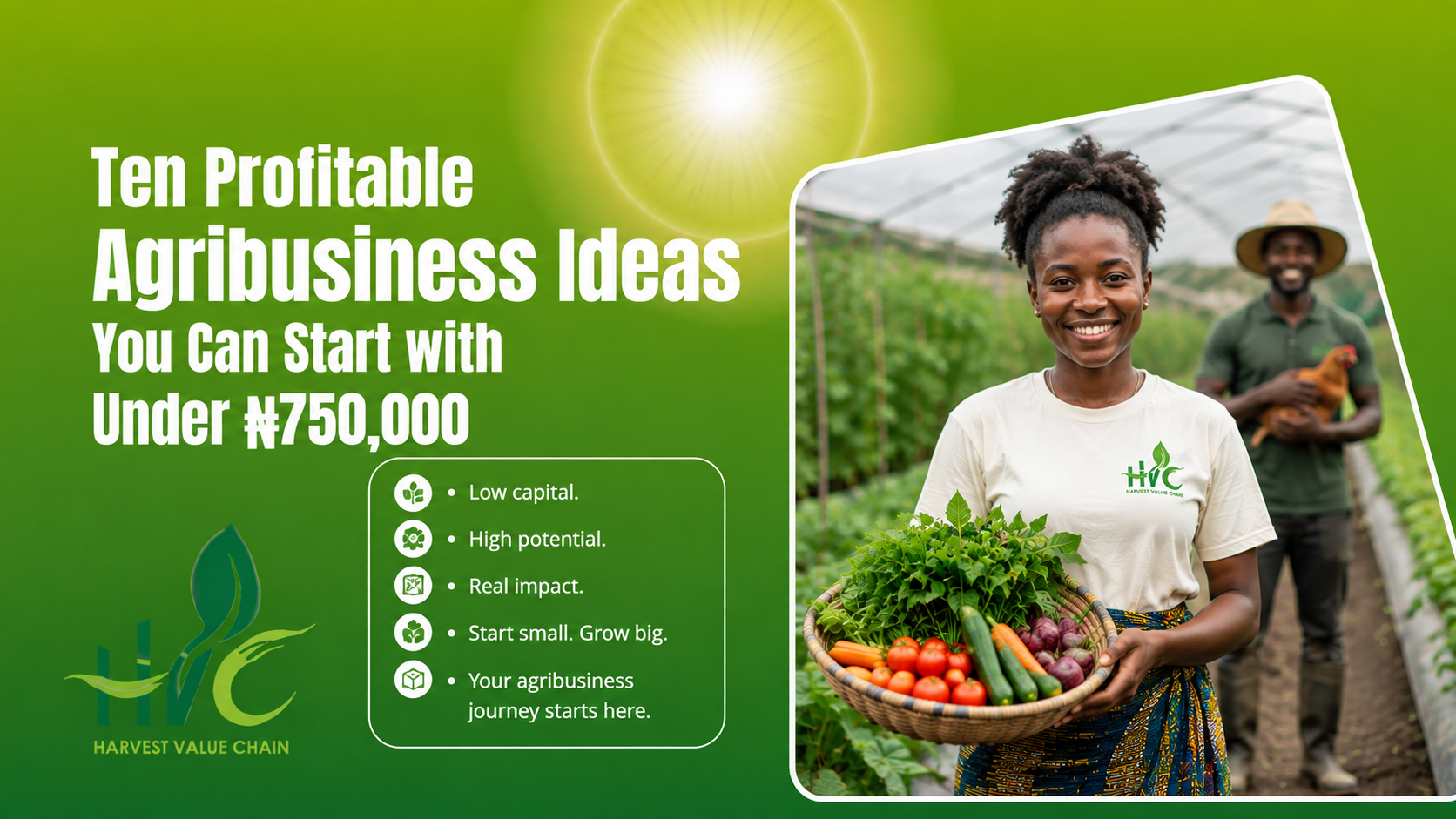
A Harvest Value Chain Limited Insight
You do not need a large farm, hectares of land, or millions of naira to enter agriculture. What you need is a business model that solves a real problem, has a clear route to market, and allows you to start small before committing more capital. That distinction matters.
Agriculture is often presented as “plant something, harvest it, and sell it.” That is an incomplete picture of agribusiness. The bigger opportunity exists across the entire value chain, from inputs and production to aggregation, processing, logistics, marketing, and waste management.
The Food and Agriculture Organization (FAO) notes that strengthening market access, processing, value addition, and relationships between value-chain actors can create opportunities for smallholders and agrifood SMEs. The World Bank similarly defines agribusiness as the network of businesses that helps move food from producers to consumers, including input suppliers, processors, transporters, traders, and technology providers.
For aspiring entrepreneurs in Nigeria, this means you do not necessarily need to become a large-scale farmer. You can build a business around agriculture. And with careful planning, some agribusiness models can be tested with less than ₦750,000 in initial capital.
Important: The budgets below are illustrative estimates, not fixed market prices. Costs vary significantly by location, season, exchange rates, equipment quality, and whether you already have access to land, water, storage, or other resources. The goal is to show what can realistically be tested at a small scale, not to promise a guaranteed return.
1. Vegetable Production on a Small Plot
Vegetables are one of the simplest ways to test a production-based agribusiness without purchasing large farmland. Depending on your location and market, you could start with crops such as pepper, tomatoes, okra, Amaranthus, cucumber, lettuce, spinach, and other leafy vegetables.
Instead of immediately trying to farm on a large scale, an entrepreneur can use a small, rented plot, backyard space, containers, grow bags, or another available production area.
A lean starter budget could be allocated toward seeds or seedlings, growing media and manure or fertilizer, basic farm tools, watering equipment, pest and disease management, irrigation materials, packaging, transportation, and a small contingency reserve.
The key is market-first production. Before planting 500 plants, identify who will buy them. Restaurants, food vendors, market retailers, households, and small processors can all represent potential customers.
Vegetables can provide relatively short production cycles compared with many tree crops, and they offer opportunities for repeated production rather than a one-time harvest. But don’t confuse a short cycle with easy money. Poor market timing, excessive production, water shortages, pests, and post-harvest losses can destroy margins.
2. Seedling and Nursery Business
You do not always have to wait months for a crop to mature before making money from agriculture. You can sell the beginning of the production cycle.
A small nursery can produce seedlings for farmers, backyard gardeners, schools, landscaping businesses, and commercial growers, including tomato, pepper, cucumber, and vegetable seedlings, fruit tree seedlings, and ornamental plants.
Farmers need healthy planting materials, and many producers would rather purchase established seedlings than spend time raising them from seed. The business can also be started in a relatively small space, using nursery trays or suitable containers, seeds, growing medium, a shade structure, watering equipment, labels and packaging, and simple pest-control materials.
The important asset isn’t just the nursery. It is your customer network. If you can build relationships with farmers before producing seedlings, you reduce the risk of producing inventory that nobody wants.
3. Mushroom Production
Mushroom farming is an example of an agribusiness that can operate in a relatively small physical space. Unlike conventional crop farming, mushroom production does not require large expanses of farmland.
A small operator can begin with a limited number of production bags or another suitable production system, learn the process, and gradually increase capacity. Potential customers include restaurants, hotels, health-conscious consumers, supermarkets, food vendors, and individual households.
Mushroom production does, however, require technical discipline. Temperature, humidity, contamination, and hygiene can determine whether a production batch succeeds or fails. That means this is not a business to enter simply because someone told you mushrooms are profitable.
Learn the production process first. Start with a small batch. Record your contamination rate, production cost, selling price, and actual profit. Then scale.
4. Snail Farming
Snail farming can be attractive for entrepreneurs who want a livestock-related business without immediately taking on the capital requirements of larger livestock operations. A small snail setup can be established using a controlled pen or suitable enclosure, depending on the production system.
Initial spending can go toward breeding stock, housing, feeding, moisture management, security, maintenance, and packaging and transportation.
The major advantage is that you can start small. The major disadvantage? Growth is slow. Anyone selling snail farming as instant passive income is selling you a fantasy. Snail production requires patience, proper housing, good hygiene, predator control, and consistent management.
The business becomes more interesting when the entrepreneur develops a reliable route to restaurants, food businesses, market traders, or consumers instead of waiting for random buyers.
5. Small-Scale Catfish Production
Aquaculture can become capital intensive at commercial scale, but a small pilot operation can be tested with a much smaller budget. Instead of constructing a massive fish farm, an entrepreneur could start with a limited number of fish using an existing or low-cost tank system.
The focus should be on understanding: fingerlings → feeding → growth → survival → harvest → market
A small budget could be used for a tank or suitable production container, quality fingerlings, feed, water management, basic equipment, medication or health management where appropriate, and transportation.
Feed will usually become one of the biggest recurring expenses, so don’t calculate profitability using only the cost of fingerlings. Track the full cost per kilogram of fish produced. That number tells you much more about whether the business actually works.
6. Spices and Dried Food Processing
Here’s where agribusiness becomes particularly interesting. You don’t necessarily have to grow the raw material. You can buy agricultural products, process them, and sell a more convenient product.
Examples include dried pepper, pepper powder, ginger powder, garlic powder, onion powder, dried vegetables, and spice blends.
Processing can extend shelf life and create a product that is easier to package, transport, and market. FAO highlights processing and other forms of value addition as important pathways for upgrading agricultural value chains and increasing the opportunities available to agrifood businesses.
A small operation could start with raw agricultural products, drying equipment or a suitable low-cost drying method, a grinder, packaging materials, labels, basic hygiene equipment, and marketing.
The business opportunity is not simply “sell pepper.” It is: buy → process → package → brand → distribute. That is value addition.
7. Farm Produce Aggregation and Reselling
This is one of the most overlooked agribusiness models for people with limited capital. You don’t need to own a farm to make money from agriculture. You can become the bridge between farmers and buyers.
For example, imagine several farmers produce tomatoes individually. A restaurant, processor, or bulk buyer may want a consistent quantity. You can aggregate produce from multiple farmers and sell it as a larger, more reliable supply.
The model can work with vegetables, pepper, cassava, maize, rice, plantain, fruits, and other locally demanded commodities.
The real skill is market coordination. You need to know who produces the commodity, who needs it, what quantity and quality they require, how frequently they buy, what price can support your margin, and how you will transport it.
Nigeria’s 2026 AGROW project specifically emphasizes aggregation, post-harvest handling, value addition, and stronger market linkages between smallholder farmers and agribusiness off takers. That tells you something important: the gap between farmers and buyers is itself a business opportunity.
8. Organic Waste Collection and Compost Production
Agriculture creates waste. Markets create waste. Restaurants create waste. Food processors create waste. But waste can also become an input.
A small entrepreneur can collect suitable organic materials and convert them into compost or other useful agricultural inputs, subject to proper handling and local environmental requirements. Potential raw materials include vegetable residues, fruit waste, crop residues, animal manure, and other suitable biodegradable materials.
The business can generate revenue from two sides: waste collection plus sale of the resulting agricultural product. This model is especially interesting because it connects agriculture with environmental management.
However, contamination is a serious issue. Mixed waste containing plastics, chemicals, or other hazardous materials should not simply be thrown into a compost pile. Start with a controlled waste stream, know exactly what you are collecting, then build the processing system around it.
9. Farm Input Retail and Micro-Distribution
Farmers constantly need inputs: seeds, fertilizers, growing media, nursery trays, basic tools, packaging materials, and irrigation components.
Instead of opening a large agricultural store immediately, you can start as a micro-distributor of a narrow range of products. For example, you might specialize in “everything a small vegetable farmer needs to start a nursery,” or “affordable irrigation and growing supplies for urban growers.”
Specialization makes it easier to understand your customers and manage limited capital. You can also combine physical sales with WhatsApp, social media, and direct delivery. The objective is not to own a giant warehouse. It is to build repeat customers.
10. Agricultural Digital Services
This is probably the most underrated idea on this list. You don’t necessarily need land, livestock, or agricultural machinery to participate in agribusiness. You can sell services to people who already have them.
Examples include farm social media management, agricultural content creation, farm photography and video, basic farm record management, digital marketing, market research, farmer-buyer matchmaking, product catalogue creation, simple website setup, and agricultural business documentation.
The World Bank describes agribusiness as extending beyond farming into services and businesses that connect producers with markets, finance, technology, and consumers. This creates an interesting opportunity for young entrepreneurs with digital skills.
A person with a smartphone, internet access, and strong communication skills can potentially start with significantly less capital than someone building a physical farm. The bottleneck is not equipment. It’s competence. If your service is mediocre, nobody cares that your startup cost was low.
Which One Should You Choose?
The biggest mistake would be choosing an agribusiness simply because it appears profitable on social media. Instead, score each opportunity against five questions:
Question
What You Should Look For
Demand
Are people already buying it?
Startup cost
Can you genuinely start at your available capital?
Production cycle
How quickly can capital return?
Market access
Do you know who will buy?
Scalability
Can the business grow beyond your first customers?
A business that scores highly across these areas deserves further investigation. A business that depends on “hopefully prices will increase” is speculation, not a solid business model.
The ₦750,000 Rule: Don’t Spend It All at Once
If you have ₦750,000 to start with, spending the entire amount on day one is usually a terrible idea. A smarter approach is to treat your first capital as validation capital.
Phase 1 — Test. Spend a limited amount to prove that customers actually want the product.
Phase 2 — Measure. Track cost per unit, selling price, gross margin, customer acquisition cost, losses, repeat purchases, and cash conversion cycle.
Phase 3 — Reinvest. Only after the model demonstrates real demand should you increase production.
This is especially important in agriculture because biological production and market prices can be unpredictable, and in Nigeria’s context, exchange rate shifts, fuel costs, and power supply can move your numbers just as much as the harvest itself.
Don’t Confuse Revenue with Profit
This deserves emphasis. Imagine you spend ₦300,000 producing agricultural goods and eventually sell everything for ₦450,000. It is tempting to say, “I made ₦150,000.” Not necessarily.
You still need to account for transportation, packaging, labour, water, fuel or generator running costs, equipment depreciation, spoilage, marketing, transaction fees, rent, and unexpected losses.
Your revenue is ₦450,000. Your profit is whatever remains after all relevant costs. This is where many small agribusinesses quietly die. The Real Opportunity Is in the Value Chain.
The future of African agriculture is not simply about producing more raw commodities. It is about creating stronger connections between production, aggregation, processing, distribution, and consumers.
FAO notes that the post-farmgate segment of agricultural value chains accounts for a very large share of consumer food expenditure globally, creating substantial opportunities in processing, wholesale, and retail. Nigeria’s agricultural sector also has significant opportunities for value-chain development, technology adoption, and value addition, according to the Federal Ministry of Agriculture and Food Security’s 2026 Agri-Food System Investment Plan.
And in March 2026, the World Bank approved a $500 million AGROW project for Nigeria focused on strengthening agricultural value chains, improving smallholder productivity, supporting aggregation and post-harvest handling, expanding agro-processing, and improving market access.
That is the bigger picture. The opportunity isn’t only “What can I farm?” It is “What problem exists between the farm and the customer, and can I build a business around solving it?”
Final Takeaway
Starting an agribusiness with under ₦750,000 is possible. But that capital is not enough to compensate for a bad business model. You can have the best seedlings, the biggest social media page, and the most beautiful farm, but if nobody wants your product at a profitable price, you don’t have a business.
Start with the market. Find the problem. Test the smallest viable solution. Track every naira. Reinvest intelligently. Then scale.
That is how a small agribusiness becomes a real enterprise.
At Harvest Value Chain Limited, we believe the greatest agricultural opportunities are created when production, technology, processing, markets, and people are connected. The future of Nigerian agriculture will not be built by farmers alone; it will be built by an entire ecosystem of entrepreneurs solving problems across the value chain.
Start small. Build intelligently. Add value. Scale deliberately.
- Finding the Next Useful Form of Agricultural Matter, Where Nothing Is Truly Waste
- Harvest Value Chain Champions Circular and Sustainable Agriculture In Kwara State (CIWACIWE)
- How Post-Harvest Value Addition Reshapes Agricultural Enterprise
- NiMet’s 21–31 August Flash-Flood Outlook: What It Means for Agriculture, Infrastructure and Logistics
- How Climate-Smart Agriculture is Shaping Africa’s Food Future
About Harvest Value Chain Limited
Harvest Value Chain Limited (HVC) is focused on building practical solutions across the agricultural value chain, from production and value addition to market connections and sustainable resource use. Follow HVC for more practical insights on agribusiness, agriculture, value addition, sustainability, and opportunities within Africa’s food system.
Leave a Reply